Arulmigu Ramanathaswamy Temple, Rameshvaram, Tamil Nadu
The eleventh Jyotirlinga and southern Char Dham — where Rama worshipped Shiva before crossing to Lanka
Understand sacred places, explore living traditions, and learn how to engage respectfully with Pilgrim Map.
Access has not been verified. Check current local guidance before planning a visit.
Rameswaram, Tamil Nadu, India
Read the sources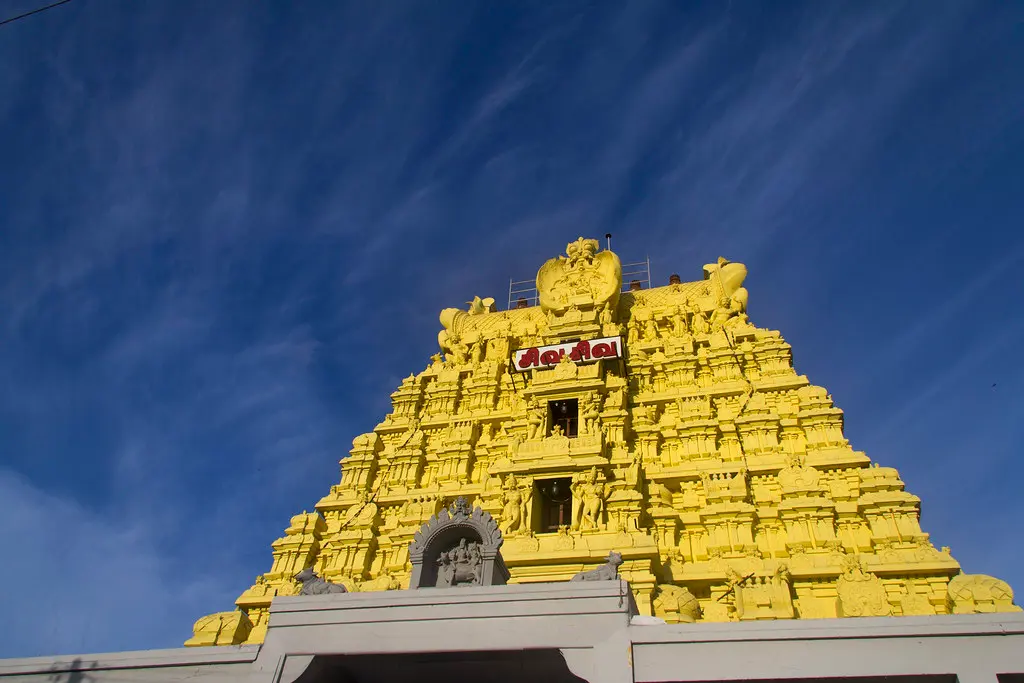
Visit essentials
A quick read before you go
- Duration
- Allow 4–5 hours for a full visit: sea bath at Agnitheertham (~1 hour), theertham bath inside…
- Access
- Rameswaram island is connected to mainland Tamil Nadu by the Pamban Bridge (road) and the new…
Overview
Few Hindu temples carry the weight Ramanathaswamy carries. It is the eleventh of the twelve Jyotirlingas, the southernmost of the four Char Dham established by Adi Shankaracharya, and the only major temple consecrated within the Ramayana itself — Rama installing Shiva in expiation for the killing of Ravana, a Brahmin. The site marks the eastern terminus of the Kashi-Rameswaram axis, the great north-south pilgrimage that brings Ganga water from Varanasi to the southern sea.
Its architectural signature is the third corridor at approximately 1212 metres — among the longest pillared corridors in the world — built by the Setupati rulers of Ramnad in the seventeenth century atop a Pandyan foundation. Inside, two lingams stand in the sanctum: the Ramalingam fashioned by Sita from beach sand, and the Vishwalingam brought by Hanuman from Kailash. By Rama's decree, the Vishwalingam is worshipped first in perpetuity — a courtesy honoured to this day.
The temple holds twenty-two theerthams (sacred wells) inside its compound; the ritual of being doused with water drawn from each, in sequence, is one of the most distinctive pilgrimages in Hindu practice.
Why this place is sacred
Rameswaram concentrates several distinct charges in one place. The island setting in the Gulf of Mannar gives the temple an oceanic openness rare in major Indian shrines; the Indian Ocean is audible from Agnitheertham, the temple's sea-bath, immediately east of the main entrance.
The ritual progression through the twenty-two freshwater wells, each said to have been drawn forth by a different arrow of Rama, takes two to three hours of slow soaking — pilgrims are doused with bucket after bucket of water by temple attendants. The third corridor's recession of sandstone columns produces an extraordinary perspectival effect, the kind of architectural depth that organises attention as much as space.
And the moment of pouring Ganga jal brought from Varanasi onto the Ramalingam — bringing northern river water to the southern sea — is, for many pilgrims, the emotional culmination of years of practice.
A Shaiva-Vaishnava convergence shrine consecrated within the Ramayana — Rama installing a Shiva lingam in expiation for the brahmahatya dosha of killing Ravana.
Tradition places the consecration of the Ramanatha lingam at the end of the Ramayana, before Rama's crossing to Lanka. The earliest historical references appear in twelfth-century Pandyan inscriptions. The present stone complex was substantially expanded between the twelfth and seventeenth centuries, with the great corridors and mandapas added by the Setupati rulers — Muthu Krishnappa, Muthu Ramalinga, and Raghunatha Setupati. The Devakottai Nagarathar Chettiar community contributed major restoration in the nineteenth and twentieth centuries.
Experience and orientation
Most pilgrims begin at Agnitheertham at sunrise. The walk down to the sea-bath theertham takes only a few minutes from the temple's eastern gopuram; the bath itself is brief but ritually charged — many describe a sense of purification deepening through the morning that follows. Inside the temple, the twenty-two-theertham sequence is a two-to-three-hour soaking pilgrimage: at each well, an attendant lowers a bucket and pours it over you.
Bring a change of clothes; wet garments are not permitted in the sanctum afterwards.
The third corridor, the architectural set-piece of the temple, runs for roughly 1212 metres. Walking it, the recession of carved sandstone columns produces a perspectival depth that photographs cannot reproduce; pilgrims commonly fall silent here.
The Sphatika lingam darshan — a quartz crystal lingam said to have been worshipped by Adi Shankara — is shown only between 4 and 5 AM and requires a separate ticket; many pilgrims describe it as luminous and exceptionally quiet, the lingam catching the lamp-flame in the predawn dark.
For a full visit, allow four to five hours: sea bath at Agnitheertham (~1 hour), theertham bath inside (~2 hours), darshan and corridor walk (~1.5 hours). Char Dham pilgrims should allow a full day on the island, including Dhanushkodi at the tip. Pre-dawn Sphatika lingam darshan at 4–5 AM is the most intimate; avoid weekends and major Tamil festival days if seeking quiet.
Context and lineage
The Ramayana records that after defeating Ravana, Rama needed to expiate the sin of killing a Brahmin (brahmahatya). On the advice of sages, he resolved to install a Shiva lingam at Rameswaram and worship it. He sent Hanuman to Mount Kailash to bring a lingam. The auspicious moment for installation neared and Hanuman had not returned, so Sita fashioned a lingam from the sand of the beach — the Ramalingam.
When Hanuman arrived with the Kailash lingam (the Vishwalingam), Rama installed it beside the Ramalingam and decreed that the Vishwalingam should be worshipped first in perpetuity — a courtesy honoured to this day.
Shaiva Hinduism (Jyotirlinga tradition), Vaishnava Ramayana devotion, and pan-Indian Char Dham pilgrimage. The temple is the rare site where these currents formally converge.
Rama
Avatar of Vishnu who consecrated the Ramanatha lingam in expiation for killing Ravana — the temple's founding figure in Puranic tradition
Sita
Fashioned the Ramalingam from beach sand when Hanuman's arrival with the Kailash lingam was delayed
Hanuman
Brought the Vishwalingam from Mount Kailash; the Vishwalingam is worshipped first by Rama's decree
Adi Shankaracharya (8th c.)
Established Rameswaram as the southernmost of the four Char Dham; the Sphatika crystal lingam is traditionally associated with his worship here
Setupati rulers of Ramnad (16th–17th c.)
Muthu Krishnappa, Muthu Ramalinga, and Raghunatha Setupati expanded the great corridors and mandapas — the temple's defining late-medieval architecture
Traditions and practice
Sea bath at Agnitheertham at sunrise; passage through the 22 theerthams within the temple (a ticketed service performed by temple attendants); abhishekam to the Ramalingam and Vishwalingam; offering of Ganga jal carried by pilgrims from Kashi; Sphatika lingam darshan in pre-dawn hours; daily Palli Arai (deity-sleeping) ceremony at 8:45 PM.
Temple open 5 AM–1 PM and 3 PM–9 PM. Sphatika lingam darshan 4–5 AM (separate ticket). Daily six-kala pujas: Palli Yezhuchi (5 AM), Sirukala Sandhi, Kala Sandhi, Uchikkala, Sayaraksai, and Ardha Jama puja. Mahakumbabhishekam every twelve years (most recently 2017). Maha Shivratri (Feb/Mar) and Thirukalyanam (Aadi/Aavani) are the major annual festivals.
Pilgrims completing the Kashi-Rameswaram axis traditionally carry Ganga jal from Varanasi or Haridwar and pour it over the Ramalingam, then carry sand from Rameswaram back north — completing the loop. For a single visit, plan to attend the pre-dawn Sphatika lingam darshan at 4–5 AM and the Palli Arai at 8:45 PM as the day's two contemplative anchors.
Shaiva Hinduism (Jyotirlinga tradition)
ActiveThe eleventh of the twelve Jyotirlingas and the only Jyotirlinga in southern India south of the Vindhyas. The presiding lingam is Ramanatha — Shiva worshipped by Rama himself.
Daily abhishekam of the Ramalingam with milk, sandal paste, vibhuti, and Ganga water carried by pilgrims from Varanasi; bilva-patra offerings; recitation of the Shiva Sahasranama and the Dwadasha Jyotirlinga Stotram.
Char Dham (pan-Indian pilgrimage)
ActiveThe southernmost of the four Char Dham sites established by Adi Shankaracharya in the eighth century — alongside Badrinath (north), Dwarka (west), and Puri (east). Completing the Char Dham yatra with Rameswaram as the south point is one of the highest meritorious aspirations in popular Hindu pilgrimage.
Pilgrims traditionally carry Ganga jal from Varanasi or Haridwar and pour it over the Ramalingam at Rameswaram, then carry sand from Rameswaram back to Varanasi — completing the Kashi-Rameswaram axis.
Vaishnava Ramayana devotion
ActiveThe site is anchored in the Ramayana: Rama installed the Shiva lingam here in expiation for killing Ravana. The temple is a rare site where Shaivism and Vaishnavism converge — a Shiva temple consecrated by Vishnu's avatar.
Pilgrims often visit Rameswaram as part of a wider Ramayana circuit, including Dhanushkodi (the legendary launch-point of the Rama Setu) and the cluster of associated shrines on the island.
Perspectives and open questions
Ramanathaswamy is held in scholarship as one of the great works of late-medieval South Indian temple architecture, in Tamil Shaiva tradition as a tirtha equal in sanctity to Kashi in the north, and in tantric Shaiva readings as a microcosmic ritual mandala of the pilgrim's body.
Scholarly perspective
Art-historians treat Ramanathaswamy as one of the great works of late-medieval South Indian temple architecture, with the third corridor — at approximately 1212 metres — among the longest pillared corridors in the world. The Pandya foundation and Setupati seventeenth-century expansion are well documented in inscriptions. The temple's role in linking Shaiva and Vaishnava devotion is widely noted in scholarship on Indian pilgrimage networks.
Living and traditional perspectives
Tamil Shaiva tradition holds Ramanathaswamy as one of the supreme tirthas of the south, equal in sanctity to Kashi in the north. The twenty-two-theertham ritual is unique to this temple and is maintained as a living practice by hereditary temple staff. The Setupati ruling family of Ramnad retains a ceremonial role.
Alternative interpretations
The twenty-two theerthams are read in tantric Shaiva traditions as corresponding to twenty-two subtle channels (nadis) of the pilgrim's body; the sequence is a microcosmic purification. The pre-dawn Sphatika lingam darshan, with the crystal lingam catching the lamp-flame, is associated with the formless light-pillar of the original Jyotirlinga manifestation.
Open questions
The exact pre-medieval material history of the site is unclear; the Archaeological Survey of India has not conducted full excavations. The geographic origin and date of the Rama Setu shoal chain visible from Dhanushkodi remains a question of debate between geology and tradition.
Plan your visit
Access and arrival
Rameswaram island is connected to mainland Tamil Nadu by the Pamban Bridge (road) and the new Pamban Rail Bridge (lift-bridge, replacing the 1914 original). Nearest railway: Rameswaram station, about 1 km from the temple. Nearest airport: Madurai (~170 km, ~4 hours by road). Frequent buses from Madurai, Tiruchirapalli, and Chennai. The temple's outer corridors are wheelchair-friendly.
Rameswaram town has extensive pilgrim accommodation from trust-administered dharamshalas to mid-range hotels. The HR&CE Department maintains guest houses near the temple.
Respectful visit
Traditional dress required: men in dhoti or veshti (some priests may ask men to remove shirts before sanctum entry); women in sari, half-sari, or salwar-kameez. Shoulders and legs covered. Western clothing acceptable in outer corridors but discouraged in the sanctum.
Strictly prohibited inside the temple. Permitted in the streets outside and at Agnitheertham beach.
Bilva leaves, sandalwood paste, milk, Ganga jal (carried by pilgrims), bananas, coconut, and traditional sweets. Offerings go to the temple priest at the sanctum or into the official hundi.
Inner sanctum traditionally restricted to Hindus. No leather inside (belts, wallets may be deposited). Theertham bath requires change of clothes. Maintain silence and unidirectional flow in the corridors during peak darshan.
The inner garbhagriha is traditionally restricted to Hindus by long-standing practice; non-Hindus are welcome in the outer corridors, the great mandapas, and at the theerthams. Photography is prohibited inside. Theertham bath requires a change of clothes — wet clothes are not allowed in the sanctum. The Sphatika lingam darshan slot is short (one hour) and requires a separate ticket bought in advance.
Current practical details
Address
E Car St, Rameswaram, Tamil Nadu 623526, India
Phone
Hours
Hours, fees, and access can change — verify on the official source before you travel. Practical details last checked Jun 2026.
Location
Map loads as you approach this section.
Pilgrim reflections
A portrait of encounter, not a score
Pilgrims describe what they felt, how present they could become, and whether the place would shape a journey. There are no stars and no ranking of traditions.
No reviewed reflections yet
The first pilgrims can help describe the character of being here.
Share a reflection
Available after an account-backed “Been there.” Every reflection is reviewed before publication.
Nearby sacred places
Explore other sacred places in the region. Proximity does not establish access or travel time; check each place’s guidance.

Nagadeepa Purana Vihara
Nainativu, Nainativu, Jaffna District, Northern Province, Sri Lanka
61.7 km away

Nagapooshani Amman Temple
Nainativu, Nainativu, Jaffna District, Northern Province, Sri Lanka
62.2 km away

Thiruketheeswaram Temple
Manthai, Manthai, Mannar District, Northern Province, Sri Lanka
79.8 km away

Nallur Kandaswamy Kovil
Nallur, Nallur, Jaffna District, Northern Province, Sri Lanka
89.2 km away
References
Sources consulted for this page. Source categories describe the publication, not a guarantee that every claim is verified. Traditional accounts and outside interpretations may differ.
- 01Ramanathaswamy Temple — Wikipedia — Wikipedia contributorsencyclopediaComprehensive overview of the 11th Jyotirlinga, Char Dham status, 1212 m corridors, 22 theerthams, Pandya and Setupati patronage.
- 02Arulmigu Ramanathaswamy Temple — Official Site — Hindu Religious and Charitable Endowments Department, Government of Tamil NaduofficialOfficial darshan timings (5 AM-1 PM and 3 PM-9 PM), Sphatika lingam darshan (4-5 AM), theertham bath fees and procedures, daily abhishekam schedule.
- 03Tamil Nadu Tourism — Rameswaram — Tamil Nadu Tourism Development CorporationofficialTourism description: 22 theerthams, Agnitheertham sea bath, access via Pamban bridge, Dhanushkodi context.
- 04Char Dham — Wikipedia — Wikipedia contributorsencyclopediaConfirms Rameswaram as the southernmost of the four Char Dham (with Badrinath, Dwarka, Puri) established by Adi Shankaracharya.
- 05Jyotirlinga — Wikipedia — Wikipedia contributorsencyclopediaRamanathaswamy as the 11th of the 12 Jyotirlingas in the Shiva Purana listing.
- 06Setupati patronage and architectural history of Ramanathaswamy Temple — Crispin Branfoot — 'The Madurai Nayakas and the Skanda Temple at Tirupparankunram' and related work on south Indian temple architectureacademicScholarly work on Setupati-era expansion of the corridors and mandapas in the 17th century; useful background for the 1212 m third corridor.
- 07Rameswaram — Wikipedia — Wikipedia contributorsencyclopediaIsland geography, Pamban Bridge, Dhanushkodi, and the Adam's Bridge / Rama Setu chain to Sri Lanka.
- 08Rameswaram Temple — visitor reviews and practical notes — Tripadvisor / Indian travel communityguideReported queue patterns, theertham bath sequence (~2-3 hours), Sphatika lingam early morning darshan logistics, dress norms.
Photo gallery
6 curated photos
Share a photo
Help visitors recognize Arulmigu Ramanathaswamy Temple, Rameshvaram, Tamil Nadu. Every submission is reviewed before publication.